Integrating similarity and dissimilarity notions in recommenders
Jan 1, 2013·, ,·
1 min read
,·
1 min read
Christos Zigkolis
Savvas Karagiannidis
Ioannis Koumarelas, PhD
Athena Vakali
Abstract
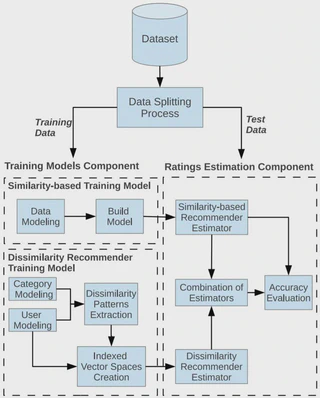
Collaborative recommenders rely on the assumption that similar users may exhibit similar tastes while content-based ones favour items that found to be similar with the items a user likes. Weak related entities, which are often considered to be useful, are neglected by those similarity-driven recommenders. To take advantage of this neglected information, we introduce a novel dissimilarity-based recommender that bases its estimations on degrees of dissimilarities among items’ attributes. However, instead of using the proposed recommender as a stand-alone method, we combine it with similarity-based ones to maintain the selective nature of the latter while detecting, through our recommender, information that may have been overlooked. Such combinations are established by IANOS, a proposed framework through which we increase the accuracy of two popular similarity-based recommenders (Naive Bayes and Slope-One) after their combination with our algorithm. Improved accuracy results in experimentation on two datasets (Yahoo! Movies and Movielens) enhance our reasoning. However, the proposed recommender comes with an additional computational complexity when combined with other techniques. By using Hadoop technology, we developed a distributed version of IANOS through which execution time was reduced. Evaluation on IANOS procedures in terms of time performance endorses the use of distributed implementations.
Type
Publication
In Expert Systems with Applications, Elsevier 2013
Note
Click the Cite button above to enable visitors to import publication metadata into their reference management software.
Note
Create your slides in Markdown - click the Slides button to check out the example.
Add supplementary notes, full text, or examples here. You can include code, math, and images.
